VibeSlice — Multi-Model Development Harness for Long-Running AI Projects
- ▸ Designed a development harness that carries AI agents through a long project in slices: a step-governed workflow with its own control plane, session handoff and resume, and a sealed record of what each slice actually did.
- ▸ Models from five rival vendors critique every spec, plan and change until they converge, and the author answers every finding on the record.
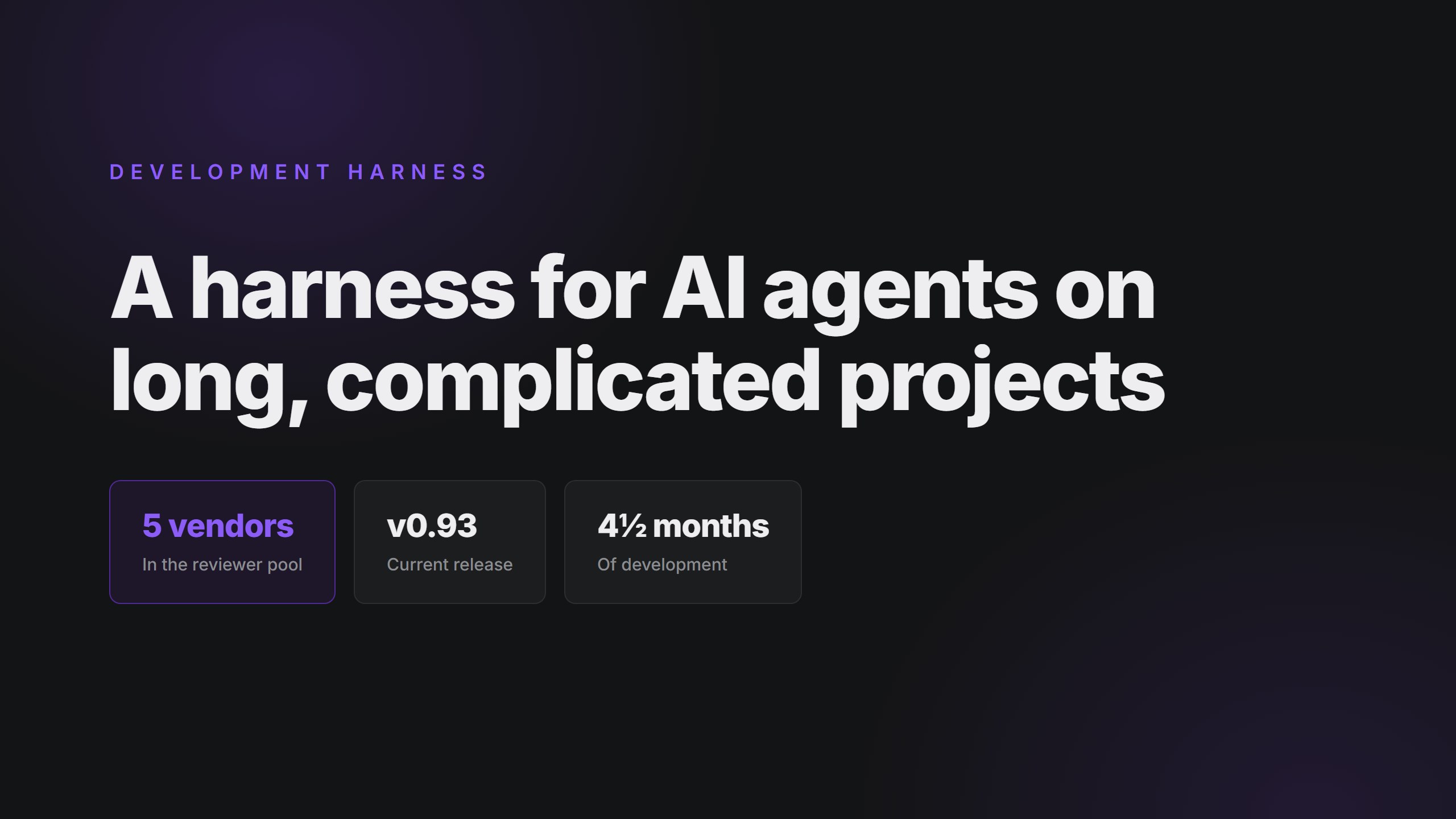
- ▸ Runs unattended overnight inside a signed authorization with a kill switch; promoting a feature still needs my sign-off. Four and a half months in, now at v0.93, all written by the pipeline.
The Problem
An AI agent is good for an afternoon. Leave it on a complicated project for months and the failures change: it forgets why earlier decisions were made, it approves its own plans, it reports work it didn’t finish, and a session that dies mid-task leaves nobody sure what state the project is in.
VibeSlice is the harness I designed for that. Work moves through it in slices, and every slice follows the same step-governed workflow from direction and spec to a merged, reviewed change. The rule underneath all of it: progress is validated against artifacts on disk, never inferred from the agent’s account of it. It is a Python control plane with a CLI and an MCP server, driven from Claude Code or Codex, and it runs the same way on every project it manages.
Results So Far
- Four and a half months of development, now at v0.93. Every version written by the pipeline and taken through its own workflow.
- Four projects run through it: GameCodeGolem and GameDevFoundry, ProjectOmega (driven from Codex), and VibeSlice itself.
- Five vendors in the reviewer pool. Cross-vendor disagreement is the review mechanism.
- Unattended overnight runs that built whole feature slices while I slept, with the promotion merge left for me in the morning.
My Role
I own the process: what each workflow step has to produce, the rules for what an agent may do unattended, the standard a slice has to meet, and the judgement calls when two reviewers disagree and both have a point. Scope decisions are mine by rule. The pipeline writes the code and takes its own changes through the same harness.
What the Harness Does
-
Workflow
One process, checked by tooling
Every slice goes through the same steps. A CLI validates the project's state against the artifacts each step requires and refuses to advance on a mismatch. Gates can't be skipped, and some steps stop for a human.
-
Continuity
Direction and state outlive the session
A standing direction document carries my intent into every session. Workflow state lives on disk, so a session that dies mid-slice resumes from the record, and a fresh session starts from the record rather than from a chat transcript.
-
Review
Critique from rival vendors
Specs, plans and code are reviewed by models from other vendors until they converge, and the author answers every finding on the record. Disputed technical questions go to a structured debate between reviewers instead of a guess.
-
Evidence
Sealed readbacks
At the end of a slice the harness renders what was actually done against what was specified, flags drift between the two, and seals the record with a digest so it can't be quietly edited afterwards.
-
Autonomy
Unattended runs with a kill switch
A director mode runs the workflow overnight inside a signed authorization that bounds what it may touch. It fails closed, keeps a ledger of every action, and cannot promote a feature. That merge stays mine.
-
Health
Diagnostics before work starts
A doctor command checks the install, the reviewer seats and the project's state at the start of a session, so a dead seat or a stale setup is found before it costs a day.
How Review Works
Author
Draft
A spec, a plan, or a code change
Review round
- Reviewer Seat 1
- Reviewer Seat 2
- Reviewer Seat 3
Each seat is a different vendor's model, drawn from Anthropic, OpenAI, xAI, Google, NVIDIA NIM.
Converged
Reviewers agree
Only then does it come to me
Fix it or argue it, then the next round
Findings go back to the author, who fixes each one or argues against it. Then the next round starts.
An author produces a slice. Reviewers on different vendors’ models raise findings. The author fixes each one or argues against it, on the record. Rounds repeat until they converge, or the loop gives up and hands the decision to me. The hard parts were elsewhere: knowing when a round has actually ended rather than when the text looks conclusive, keeping a reviewer’s memory of the argument across rounds, and telling a vendor outage apart from the end of a review.
What It Caught
All four came out of review on ProjectOmega, on code that compiled, passed a smoke test, and had already been approved by a single model.
-
Code review
The host's call for help never reached the other player
A multicast on the wrong class only ever reached its own connection. Moved, with a test written to fail first.
-
Architecture review
A weapon that would lock up after one early shot
Routine server rejections didn't advance the request counter, so every later shot looked out of sequence.
-
Code review
A same-tick crash between two player states
One player bleeding out while another went down in the same tick crashed the server. Found before sign-off.
-
Technical debate
An ability system that may not exist yet on a joining client
Settled across several reviewers rather than guessed at, and the resolution is now the project's standing rule.
Where It Doesn’t Help
Review is slower than no review and costs real money per slice. It catches reasoning errors well and runtime behaviour badly: reviewers will argue confidently about code none of them has run. On the game, a misspelled engine console command survived three rounds and was only caught when it executed. One packaged build silently used the wrong map, which no amount of reading would have found. So review is not the bar for done. A packaged two-player run is, and I play every slice myself.
The harness also costs process. Every slice carries its spec, plan, reviews and readback, which is more ceremony than a one-afternoon change deserves. It earns that back on projects long enough to forget their own history, which is what it was designed for.
Tools & Tech
Python, Model Context Protocol, a workflow CLI and MCP server, Codex CLI and Claude Code as drivers, pytest, Git, and reviewer seats across Anthropic, OpenAI, xAI, Google and NVIDIA NIM-hosted open models.
Want AI agents that can carry a project for months?
Tell me what you're building and what you need. I typically respond within 24–48 hours.
Start a Conversation